



When a major steel producer acquired an existing paint facility located in close proximity to its southeastern U.S. sheet mill, the intent was to expand the mill’s value-added capabilities and expedite its ability to bring coated materials to market.
However, the path to get there was anything but straightforward.
A Line Running on Borrowed Time
While the company saved tremendous time and capital by purchasing an existing facility and inheriting a fully functional team, budget constraints meant it had to make use of existing equipment in the line, which included an older tension-leveling system that boasted an early design. Functionality was basic – it was driven by a geared-together bridle roll setup with a mechanical elongator drive. Because of this, the steel producer faced a significant challenge operating and maintaining the legacy tension leveler, a critical part of the production process.
According to Dan Brown, Machine Concepts Project Manager, the company quickly discovered that the equipment was limited in its ability to shape-correct the strip for all products running through the line, especially newer high-strength alloys. Additionally, the equipment was in extreme disrepair, with worn-out gears and bearings. In some cases, machines were covered in grease and sitting in ½-in. puddles of oil. They were also outdated, upwards of 40 to 50 years old. Together, these variables resulted in a variety of problems.
First, the equipment’s leveling ability was slow and unreliable, resulting in persistent shape defects that affected overall quality. Because of the nature of an elongator drive setup, chatter in the strip can occur if the roll diameters and the amount of material stretching due to the tension don’t align exactly. This limited the bridle’s ability to multiply the tension to desired levels without chatter. In addition, original drawings indicate a tension capability of 11,500 lbs. delta, but a rough estimate of gearing strength by a third party suggested only 7,300 lbs. delta capacity.
“They could only level certain products. The rest, they leveled the best they could with what they had. They also were line speed limited when they used the tension leveler, so throughput was reduced, and meeting delivery deadlines could be problematic,” Brown said.
Second, the improperly leveled material yielded inconsistent coating results that did not meet the company’s high standards. Third, due to the equipment’s age, performing maintenance and acquiring necessary parts was extremely challenging, if not impossible, said Chris Heid, Leveler Product Manager at Machine Concepts.
“This bridle system’s an old mechanical system that they have struggled getting parts for anymore. It was becoming a major thorn in their side and a major concern for their whole process. This can shut down the whole line,” Heid explained.
Finally, operating the equipment was complex, and the experienced operators who once knew it best were gone.
“The first time we went there, they just had this sheet of paper with a bunch of numbers on it, and that’s how they set the machine up,” said Kirk Dicke, Coil Processing Director at Machine Concepts. “They had no idea where these numbers came from or what they did; they just plugged the numbers in, and the machine seemed to work OK. But they wanted better than that,” Dicke explained.
The Search for a Real Solution
After commissioning a third party to conduct an engineering study to determine the best path forward, it was determined that a new tension-leveler bridle system was the first priority, followed by the tension-leveler cassette and rolls. Specifications defined exact requirements for the gearbox service factor, rolls and bearings, motors and encoders and load cells.
Budget constraints and the existing support framework — shared by the tension-leveler cassette and rolls — meant it was necessary to custom design a bridle system to preserve the original bridle roll position.
In its quest to improve the technical performance and shape-correction leveling on the coating line, the company reached out to Machine Concepts, with which it was already familiar through previous working relationships.
Over the course of four years, Machine Concepts engineers evaluated the options and refined the project through various iterations. For additional proof of concept, the steel producer even sent material to another manufacturer with a Machine Concepts roller leveler on its shop floor and found that it effectively removed dents and flatness issues.
For the Machine Concepts teams, navigating long sales cycles and complex requirements to find solutions that fit both the need and the budget is right in their wheelhouse. After careful evaluation and incorporating changes and refinements, the steel mill committed to purchasing a solution from Machine Concepts.
Shortly thereafter, a critical line failure further solidified their need for an upgrade.
The worn-out, under-maintained bridle elongator drive system, which had limited tension capability, experienced a critical failure, solidifying their need for an upgrade.
“They were down for, I believe, over a week, just trying to make repairs to it,” explained Brown. “So that really highlighted the risk of not upgrading this equipment. It was unplanned downtime, and I’m sure they had some customers with late metal deliveries. That was a big thing for them, just to get reliability on meeting schedules.”
From Breakdown to Breakthrough
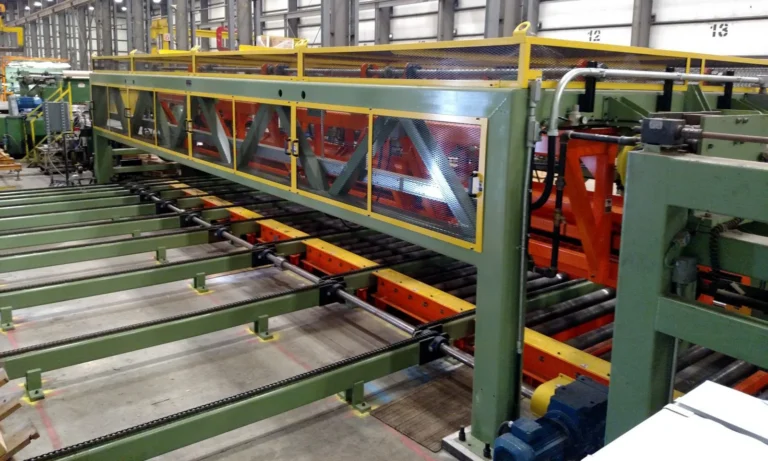
Machine Concepts engineered a solution from the ground up to match the customer’s exact footprint and performance requirements. It installed four 36-in.-dia. x 72-in. face bridle rolls driven through Sumitomo Paramax gearboxes, ABB Baldor RPMAC motors, System Components, Inc. (SCI) Powertork flange-type gear couplings, and Hilliard caliper brakes. The equipment also included SKF cast steel split pillow blocks, Kelk load cells mounted under chrome rolls with a measuring wheel affixed to a Nidec Avtron tachometer, pneumatic controls and four custom-made base frames.
The equipment was assembled at Machine Concepts and then shipped to the customer’s location as four separate units. Once the equipment arrived on-site, Machine Concepts provided 24-hour engineering support for several days, overseeing installation and ensuring precise alignment of the rolls and shafts. This hands-on approach helped guarantee everything was properly connected and enabled the customer to deliver the finished solution within a very tight timeline, without delays despite the project’s scale.
The upgrade performed exactly as promised, and then some. The new tension-leveling system more than doubled tension capacity, from 11,500 lbs. to 25,000 lbs., while boosting line speed to 550 FPM with a 700 FPM ceiling. Shape correction is significantly improved, and throughput speed has increased by 83% on thicker products and 40% on thinner ones. Replacing the tension-leveler cassette and rolls remains a planned future upgrade.
The performance gains were significant, but the impact on the people running the line may have been even greater. Operators now understand set points and line capabilities, take pride in their work and trust the equipment they’re running is safe.