



You’ve identified the need for a custom automation solution on your shop floor. Now what? A lot happens between identifying a need and commissioning that new custom solution. So much, in fact, that it can be difficult to know where to start, and that uncertainty can be paralyzing.
Your shop floor, after all, is unlike anyone else’s. Your footprint, product mix, cycle times, upstream and downstream equipment and workforce are completely unique to your business. So it doesn’t make sense to implement anything less than automation engineered with your unique variables in mind.
Machine Concepts is an engineering-based machinery builder headquartered in Minster, Ohio. Our Custom Automation group designs and builds turnkey automation systems, robotic integration cells, automated packaging lines and more for manufacturers in automotive, appliance, packaging and general industry.
As a Fanuc Authorized System Integrator and authorized integrator for KUKA, Yaskawa and Lincoln Electric, we have the engineering depth to design a solution from scratch and the partnerships to source and program the right hardware for each application.
But knowing we can build it is only half the equation — you need to know what the process looks like on your end. Here’s what to expect from the first call to the first part.
Phase 1: Discovery
Every project starts the same way: by listening.
Before anything is solidified, our engineering and sales team must understand your process — not just what you want built, but why you need it. What is the current bottleneck? What are the safety or ergonomic concerns? What does the upstream and downstream equipment look like? What are the cycle time targets? What constraints does the floor layout impose?
That typically begins with an on-site visit to your facility. Our engineers will walk the line, observe the existing process and talk with the operators and maintenance staff who work the equipment every day. Our goal is to understand the chronic problems they’re experiencing, the workarounds they’ve deployed and the constraints.
From there, we’ll develop 2D process flows and 3D proposal layouts that map the solution to your specific environment. Material and efficiency calculations follow, giving you concrete performance expectations before you commit. The discovery phase culminates in a quote and lead time, which we review in detail with your team.
We treat the discovery phase as engineering work because the solution’s quality depends on the information we receive, and it’s our job to ask the right questions to get it.
When Discovery Revealed the Real Problem
For example, when a major appliance manufacturer came to us with a manual packaging process that required six operators and averaged 30 seconds per unit, the discovery phase revealed that the real challenge wasn’t just speed — it was the physical toll on workers and the difficulty of staffing the line. That understanding shaped every decision that followed, from robot selection to conveyor layout to how box sizes were verified.
Phase 2: Production
Once you approve the quote, your project enters the production phase — and this is where working with a custom builder looks fundamentally different from buying off-the-shelf equipment.
Machine Concepts assigns a dedicated project manager who serves as your single point of contact from kickoff to commissioning. The engineering work itself happens under one roof. We have more than 40 full-time engineers — mechanical, electrical and controls — working in a nearly 100,000-sq.-ft. facility in Minster, Ohio. That in-house depth means one team coordinates mechanical design, controls engineering, robot programming and system integration from the start.
During the build, you will receive an approval drawing package — detailed engineering drawings that your team reviews and signs off on before fabrication begins. This is your checkpoint. If a clearance needs adjusting or an integration point needs revisiting, this is where it happens.
We then test and simulate the solution during what we call factory acceptance testing. This is where we run a full test of the system on our floor before shipping it to you.
Change Orders Don’t Deter Us
Custom projects rarely go from quote to build without a single change. What matters is how your equipment builder handles it.
When we partnered with Arbor Metals on a coil processing line rebuild that coincided with a full facility move, the scope expanded through 11 change orders. Through every change, we held firm on the original ship date and delivered exactly seven months from PO. Though that project fell under our Coil Processing division, the discipline is the same across every group: a dedicated project manager tracks the impact of each change, engineering absorbs the added complexity and the commitment to your deadline does not move.
Phase 3: Post-Production
Once factory acceptance testing is complete and the system passes final acceptance, we coordinate shipping and travel to your site for installation, start-up and commissioning. The equipment arrives with as-built assembly drawings and a complete bill of materials with OEM part numbers. Installation is followed by operator and maintenance training.
Aftermarket Support: The Relationship Doesn’t End at Commissioning
When you call our service line, you talk to someone who knows your machine. They can help diagnose a problem over the phone, ship a replacement part the same day and, if needed, send a field service technician to your site.
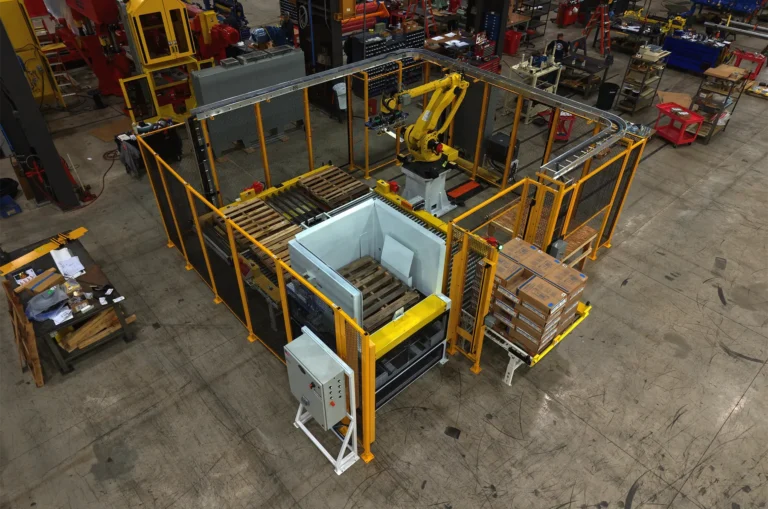
That level of responsiveness matters when downtime costs dollars per minute. It is also one reason our customers come back. For example, Eaton completed multiple projects with us before commissioning the palletizing cell. Knowing that the team who built your last cell will answer the phone two years later changes the math on vendor selection.
What Your Team Should Prepare Before the First Call
The clearer you can define the problem, the faster discovery moves and the better the solution fits. Here is what we find most helpful during an initial conversation:
- The problem you’re solving — not the machine you think you need.
- Cycle time targets — what does your line need to produce per minute, per hour or per shift?
- Floor layout constraints — available footprint, ceiling height, proximity to upstream and downstream equipment, forklift aisle requirements.
- Integration points — what equipment does the new cell need to communicate with? Existing conveyors, PLCs, HMIs, MES systems?
- Budget range and timeline — even a rough range helps us determine how to scope the proposal.
- Any safety, ergonomic or regulatory requirements that the solution must address.
Got a Project in Mind?
Our team is ready to talk it through with you and start the discovery phase.